Why the Market Doesn't Care About Your £/sqm Calculation
Economy | 24 Jun 26, 00:00
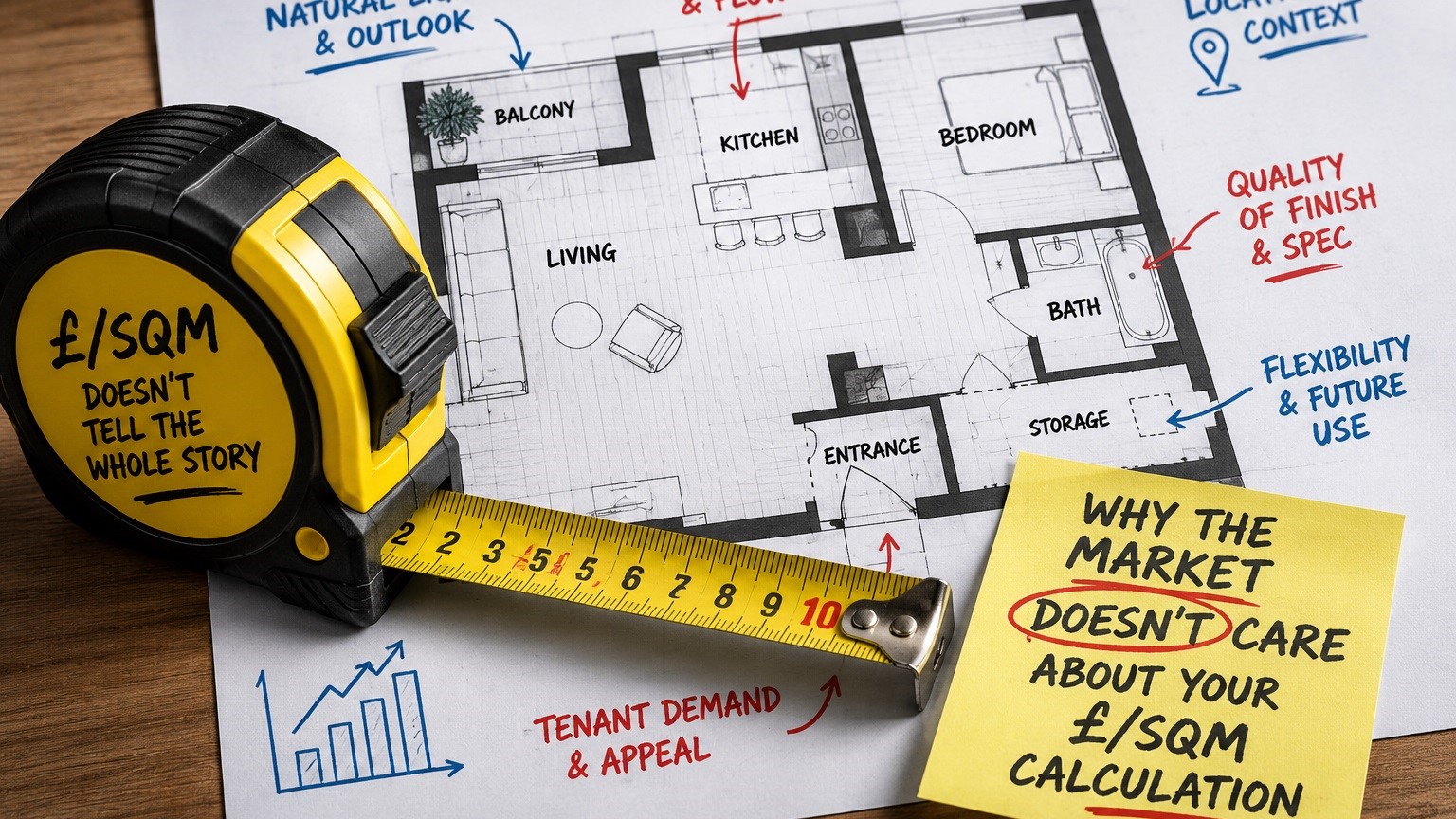
Few metrics in property are quoted as often (or misunderstood as frequently) as price per square metre.
It's neat. It's simple. It's easy to compare. And that's precisely why so many people love it.
The problem? Property buyers don't.
At least, not in the way many commentators, portals and armchair analysts would have you believe.
If you've spent any time browsing listings, you'll have seen people comparing developments, apartments and even entire neighbourhoods purely on their £/sqm figures. The assumption is that lower equals better value and higher equals overpriced.
Reality, as it so often does, refuses to cooperate.
At Richardsons, we've sold enough property to know that buyers don't arrive armed with a calculator and a tape measure. They arrive with aspirations, preferences, priorities and budgets. They buy homes, lifestyles and opportunities, not simply square metres.
The numbers tell the story.
Last year, our highest achieved £/sqm figure was an eye-watering £11,296 per square metre, while our lowest was £3,703 per square metre.
At first glance, that sounds like evidence that one property was wildly overvalued and another was massively underpriced.
It wasn't.
Both transactions reflected exactly what the market was willing to pay.
Some might argue that's because they were entirely different developments, serving different segments of the market. That's true to an extent. But the myth really starts to unravel when you look within individual developments.
In one building alone, we saw a differential of approximately 30% in achieved £/sqm values between comparable apartments.
Same building.
Same address.
Same facilities.
Same age.
Yet dramatically different £/sqm.
Why?
Because buyers don't value all square metres equally.
A west-facing apartment with uninterrupted sea views will command a premium over one looking into a neighbouring building.
A penthouse may achieve substantially more than an identical-sized apartment on a lower floor.
A property with a larger terrace may attract stronger demand.
A corner unit may offer better natural light.
An apartment positioned away from road noise may appeal more than one directly above a busy street.
The list goes on.
The notion that every square metre carries identical value is one of the most persistent misconceptions in real estate.
Imagine two identical 70sqm apartments. One enjoys panoramic views across the Bay, while the other overlooks an air-conditioning plant. Their internal measurements may be identical, but no rational buyer would value them equally.
Yet a strict £/sqm analysis effectively assumes they should be.
This is where property portals can unintentionally add to the confusion.
Take the way some listings calculate floor area. PropertyGibraltar, for example, includes only 50% of external space when producing its quoted square metre figures.
That sounds reasonable enough on paper.
But who decided that a terrace is worth exactly half of an internal room?
More importantly, does the market agree?
Consider two one-bedroom apartments.
Apartment A offers 45sqm internally and a 5sqm roof terrace.
Apartment B offers 48sqm internally and no outdoor space whatsoever.
Using a standardised formula that discounts external space, Apartment A may appear smaller and therefore less valuable.
Yet in today's market, where outdoor space remains one of the most sought-after features, many buyers would choose Apartment A every single time.
In fact, many would happily pay more for it.
The terrace isn't simply an extension of the floor plan. It's a morning coffee spot, an outdoor dining area, a sunbathing space, a pet-friendly feature and, in Gibraltar's climate, effectively another room for much of the year.
For certain buyers, those 5sqm outside may be worth considerably more than the additional 3sqm inside.
And that's the point.
The market doesn't follow formulas.
People do not purchase property according to a universal equation. Different buyers place different values on different features.
One buyer will pay a premium for a marina view.
Another cares only about proximity to a particular school.
One wants a large terrace.
Another wants minimal maintenance.
One prioritises parking.
Another doesn't even own a car.
Some buyers are investors focused on rental yield. Others are owner-occupiers making an emotional decision about where they'll spend the next decade of their lives.
Trying to reduce all those motivations into a single £/sqm figure is like judging a restaurant purely on the weight of the food served.
You might know how much you're getting.
You still have no idea whether it's any good.
Of course, price per square metre isn't completely useless.
Far from it.
It can provide a useful reference point. It can help identify anomalies. It can offer broad comparisons between developments or locations.
The problem arises when it becomes the only metric people consider.
That's when nuance disappears.
That's when buyers overlook exceptional opportunities because a spreadsheet says something is expensive.
And that's when sellers become convinced their property should be worth more simply because another apartment achieved a higher £/sqm figure.
Professional valuation has always been as much art as science.
Data matters enormously. Comparable evidence matters. Market trends matter.
But understanding what buyers actually want matters even more.
At Richardsons, that's the foundation of every appraisal we undertake.
We don't start with a tape measure and work backwards.
We start with the market.
We analyse buyer demand, current supply, competing stock, unique features, outlook, floor level, outdoor space, parking, condition, layout and dozens of other factors that influence purchasing decisions.
Because that's exactly what buyers do.
Not consciously perhaps, but collectively.
Every completed transaction represents thousands of individual judgements made by real people deciding what they believe a property is worth.
That is the market.
And the market rarely thinks in simple £/sqm terms.
So the next time you hear someone declare that a property is overpriced because its price per square metre looks high, or undervalued because the figure appears low, remember this:
A square metre is not a commodity.
One square metre can contain a breathtaking sea view, a sun-drenched terrace, perfect natural light or a premium position that buyers are willing to fight over.
Another can contain none of those things.
The measurements may be identical.
The value rarely is.
Property has always been about far more than the dimensions on a floor plan.
And that's why, at Richardsons, we appraise property based on what the market will actually pay for it, not simply how far the tape measure stretches.