The Wait Is Over: What Gibraltar's New Residency Rules Really Mean
Economy | 23 Jun 26, 00:00
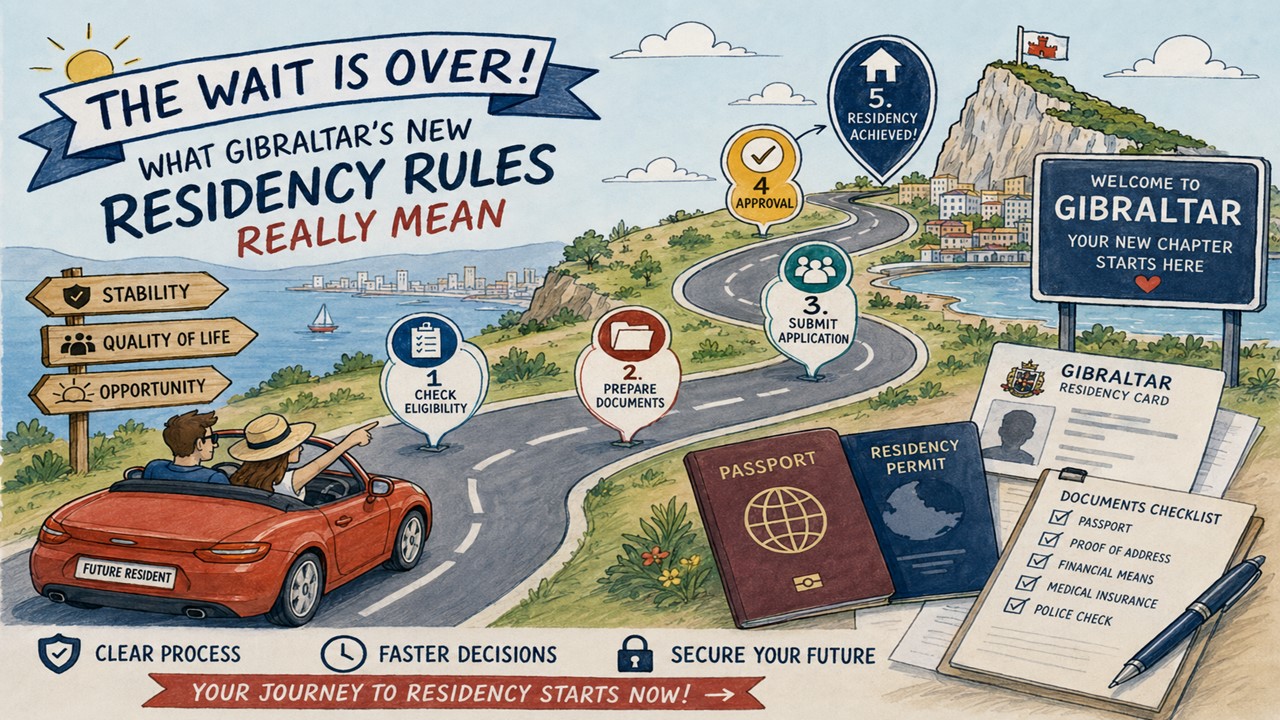
For months, the question has been the same in boardrooms, coffee shops, estate agency offices and WhatsApp groups across Gibraltar: "So, what are the new residency rules actually going to look like?"
Well, now we know.
The Government's long-awaited residency framework has finally landed, and while it won't affect existing residents, it will significantly change the landscape for anyone looking to make Gibraltar their home after 6 October 2025.
The headline message is simple: Gibraltar remains open to talent, investment and entrepreneurship, but future residents will be expected to demonstrate a genuine commitment to living, working and contributing here.
In other words, residency is no longer simply about arriving in Gibraltar. It's about becoming part of Gibraltar.
So, what does that mean in practice?
Existing Residents Can Relax
Before anyone starts checking expiry dates and digging out old paperwork, it's worth stressing that the new rules are not retrospective.
Anyone who already holds a Gibraltar Identity Card / Civilian Registration Card, or who obtained residency before 6 October 2025 will remain under the existing framework. Their route towards Gibraltarian Status remains unchanged. The length of residency required for permanent residency / Gibraltarian status remain as they were.
The changes are aimed squarely at future applicants.
So if you're already resident, this is largely a case of "carry on as you were."
If you're planning a move after October 2025, however, read on.
A Job Alone Won't Be Enough
At the heart of the new policy is a principle that has appeared repeatedly throughout the Government's proposals: economic contribution.
Future residents will generally need to show they are employed in Gibraltar and earning at least the average annual salary, currently around £37,500.
The objective is to ensure that those benefiting from residency are also contributing to Gibraltar through employment, taxation and social insurance.
For employers, this creates a clearer framework when recruiting overseas talent. For employees, it establishes a benchmark that must usually be met before residency is granted.
There is, however, a concession for younger workers. Applicants under 30 may still qualify even if their salary falls below the threshold, provided their employer pays tax and social insurance contributions as though they were earning the full average salary.
The Government clearly wants to attract young talent, while ensuring Gibraltar still receives the economic contribution associated with full-time employment.
The Property Market Takes Centre Stage
For estate agents, landlords, buyers and anyone considering relocating, one section of the new rules stands out immediately.
Applicants must now prove they have secured suitable accommodation in Gibraltar.
Whether rented or purchased, the property must be the applicant's primary residence.
Short-term rentals won't qualify. Holiday lets won't qualify. A friend's spare room won't qualify.
Rental agreements must run for at least twelve months, while purchased properties must remain available for the applicant's own use throughout the duration of the residence permit.
The days of obtaining residency without establishing a genuine residential footprint appear to be coming to an end.
For Gibraltar's property market, this creates an even stronger connection between housing and residency than ever before.
Entrepreneurs Welcome... But Bring a Business Plan
The Government has also tightened requirements around start-ups and newly established businesses.
Those joining businesses that have been trading for less than a year, as well as first-time self-employed applicants, may be required to lodge deposits covering estimated tax and social insurance obligations.
This isn't intended to discourage entrepreneurs. Rather, it serves as a safeguard to ensure that businesses entering Gibraltar's economy are properly established and compliant from the outset.
Businesses will also need to demonstrate genuine economic activity, including factors such as job creation, office space and future economic contribution.
The message is clear: Gibraltar wants real businesses, not paper businesses.
The New Age Threshold
One of the most talked-about changes is the introduction of an age limit.
Applicants will generally need to be aged 55 or under when applying for residency.
That said, this is not an absolute rule. The Chief Minister will retain discretion to approve applications where residency is considered beneficial to Gibraltar.
The thinking behind this measure is linked to long-term sustainability. The Government wants new residents to contribute economically for a significant period before becoming eligible for certain longer-term rights and benefits.
For some prospective retirees, this may require a rethink. For younger professionals and families, it is unlikely to be a major obstacle.
A Longer Road to Gibraltarian Status
Perhaps the most significant long-term change is the extension of the qualifying period for Gibraltarian Status.
Thos redsident before October 2025 can still apply after ten years.
Under the new framework, anyone becoming resident after 6 October 2025 will generally need twenty years of residence before becoming eligible.
That's a substantial change.
The Government's position is that long-term rights should reflect long-term contribution, and the new rules are designed to align those two concepts more closely.
For newcomers, Gibraltar is still very much a destination for the future. It just requires a longer-term commitment.
Residency Isn't a One-Off Exercise
Another important shift is the introduction of annual renewals.
Residents will need to confirm each year that they continue meeting the relevant conditions.
Employment must remain valid. Tax and social insurance contributions must be up to date. Material changes in circumstances must be disclosed.
If employment ends, residency can lapse unless a new qualifying position is secured within a relatively short timeframe.
In effect, residency becomes an ongoing relationship rather than a one-time application.
What Benefits Remain Available?
The answer is: quite a few.
Residents, their spouses and children will continue to benefit from healthcare coverage and access to Gibraltar's education system.
Dependent children may also become eligible for scholarship support after ten years of continuous lawful residence and contributions.
However, some benefits remain reserved for those who ultimately achieve Gibraltarian Status, including elderly residential services, domiciliary care and certain other social benefits.
The distinction is deliberate. Residency provides access to core services, while full integration into Gibraltar's social support framework comes later.
So, What Does It All Mean?
After months of speculation, the overall direction is now clear.
Gibraltar is not closing its doors.
Far from it.
The new residency framework is designed to attract people who genuinely intend to build a life here, contribute to the economy, pay taxes, support local businesses and become part of the community.
For the property market, that means accommodation moves from being a practical consideration to a central requirement.
For employers, it creates greater certainty around recruitment.
And for prospective residents, it provides a clearer roadmap of what is expected in exchange for the opportunity to call Gibraltar home.
One thing is certain: if you've been waiting months for answers, you've finally got them.
Disclaimer: This article is provided for informational purposes only and does not constitute legal advice. For independent guidance on residency and relocation, Richardsons can connect you with relocation specialists who can support you throughout the process.