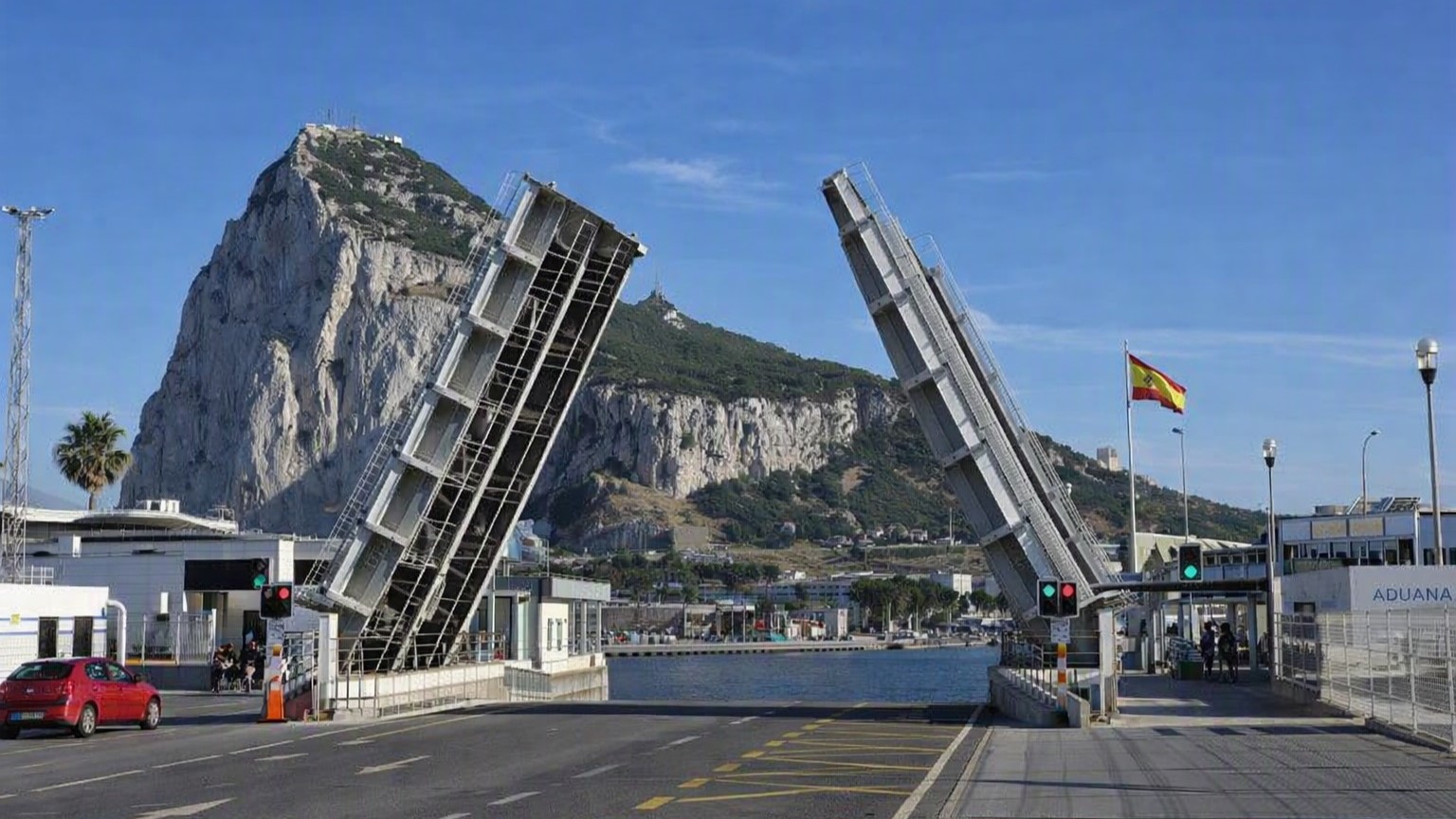
Opened the Border but Pulled Up the Drawbridge
Economy | 17 Aug 26, 00:00
A comprehensive view of goings on over the past 12 months
by Paul Gibbens MNAEA, Sales & Lettings Manager, Richardsons
There is a certain irony in where Gibraltar finds itself today.
For decades, one of the biggest frustrations of living and working on the Rock has been the border. Anyone who has sat in a queue stretching back towards the airport, watched workers time their journeys around the frontier, or had a viewing appointment complicated by an unexpected delay will understand just how much the physical border has shaped everyday life - and, indirectly, our economy and property market.
Then, in June 2025, came the announcement that seemed to change everything
After years of uncertainty, the UK, Gibraltar, Spain and the European Commission reached a political agreement on the core elements of a future treaty. The headline was extraordinary: physical barriers, checks and controls on people moving between Gibraltar and Spain would be removed. The objective was not simply to make the daily commute easier, but to create greater confidence, certainty and shared prosperity across the region.
For the Gibraltar property market, it felt like the opening of a new chapter.
But there was another story unfolding at almost exactly the same time.
While Gibraltar was preparing to open its physical border to Europe, it was becoming considerably more selective about who could cross the metaphorical border into life here.
And that, in my view, is one of the most interesting developments in our property market over the past year.
We have opened the border - but we have also pulled up the drawbridge.
I don't necessarily see that as a negative. In fact, I think it could ultimately prove to be one of the most important reasons why Gibraltar's property market remains resilient.
The market we inherited
To understand what has happened since June 2025, it is important to remember where the market was starting from.
Gibraltar's property market had already been through an extraordinary cycle. The post-Covid boom pushed values significantly higher, with prices rising by 50% to 100% in some segments over a relatively short period. What followed was a period of correction and realignment.
Transaction numbers tell part of the story. Real estate transactions fell from 638 in 2023 to 344 in the 2024/25 period, while the total value of deals fell from £366.5 million to approximately £202.2 million.
On the face of it, those numbers could look concerning.
But I think they tell us more about transaction volumes than they do about the underlying health of Gibraltar property.
Prices have remained remarkably resilient. The Government itself noted that estate agents had continued to report little change in sale prices per square metre, despite the fall in transactions. It also pointed to higher interest rates, the post-Covid correction, limited new development completions and - importantly - buyers waiting for greater certainty around the Gibraltar treaty.
In other words, the market was not necessarily suffering from a lack of interest. It was suffering from hesitation.
That distinction matters.
Property is an illiquid asset. People can postpone buying a home for six months. They can wait for an election, an interest-rate decision, a new development, a treaty or simply a clearer picture of what the future looks like.
And throughout 2024 and the first half of 2025, the Gibraltar treaty was very much part of that picture.
Then June changed the conversation
The June 2025 announcement changed the tone almost immediately. What had previously been a question - would Gibraltar eventually have a more fluid relationship with Spain and the Schengen area? - became a much more tangible proposition.
For anyone considering Gibraltar as a place to live, work or invest, the proposition suddenly became considerably more compelling. Here was a British territory with a familiar legal system, a Mediterranean lifestyle, a relatively attractive tax environment and a sophisticated international business community, potentially combined with far easier access to Spain and the wider Schengen area.
That last point is particularly important.
Gibraltar has always been geographically close to Europe, but geographical proximity is not quite the same thing as practical accessibility. What the treaty does is make that proximity far more useful in everyday life. The political agreement envisaged the removal of checks at the Gibraltar–La Línea crossing, with the necessary Gibraltar and Schengen immigration controls instead being carried out at Gibraltar's airport and, where necessary, its port.
It is an important distinction because this is not literally Gibraltar "joining Schengen". Gibraltar remains outside both the EU and Schengen. What changes is the experience of moving between Gibraltar, Spain and the wider Schengen area — and for property, experience matters.
A location can be attractive on paper, but if getting in and out of it is unpredictable, that inevitably becomes part of the buyer's calculation. Remove that friction and the location itself becomes more attractive.
We began to see that change reflected in the enquiries coming through to estate agents.
Perhaps the clearest indication of the shift was not found in a government statistic or a property index, but in the conversations taking place with people who were actively considering whether Gibraltar could become their home. The Chief Minister reported that residency enquiries rose from around 1,000 a year to approximately 3,000 in the three months following the June announcement.
That does not mean three times as many people were suddenly buying property. But it does mean that three times as many people were sufficiently interested in Gibraltar to investigate whether they could actually live here.
And that, in my view, is one of the most valuable things the treaty has given the property market: a larger pool of potential buyers.
For years, Gibraltar property has been primarily a local market with a significant international component. The treaty has made the international proposition much easier to explain. A potential buyer sitting in London, Manchester, Dublin, Madrid or elsewhere in Europe can now look at Gibraltar not simply as an isolated British territory at the southern tip of Spain, but as a base from which Europe is considerably more accessible.
That changes the conversation - and potentially the market with it.
...and then came the drawbridge
There is, however, a natural tension here.
If you make Gibraltar more attractive, more people will want to come.
But Gibraltar is not a city with unlimited land waiting to be developed.
It is one of the world's most physically constrained property markets. The Rock is only around 6.8 square kilometres, with a substantial proportion forming the Upper Rock Nature Reserve. Much of our development has historically depended on reclamation, redevelopment and building upwards.
We cannot simply respond to a sudden increase in demand by building another suburb.
And this is where the new residency framework becomes particularly relevant to property.
In October 2025, new residency applications were paused while the Government developed a new system. The pause came after the extraordinary increase in enquiries following the treaty announcement.
The new framework, now in force, is much more focused on genuine economic contribution and the sustainability of Gibraltar's public services.
For a standard employee application, the requirements now include an employment contract of at least one year, gross annual earnings of at least £37,500, appropriate accommodation in Gibraltar, and normally being aged 55 or under.
That last point is significant.
The traditional idea of Gibraltar as a straightforward retirement destination has changed. It would be wrong to say that absolutely no person over 55 can now become resident - the Chief Minister retains discretion where residency is considered to be in Gibraltar's interests - but there is no longer a broad, automatic route for new retirees in the way people may have previously understood it.
There is also a significant change in the longer-term residency landscape. For people becoming resident from 6 October 2025, the pathway to Gibraltarian Status has been extended to 20 years, compared with the previous 10-year route for those who were already resident before that date.
At first glance, these changes might look like bad news for property.
I am not convinced they are.
Quality rather than quantity
The easiest way to judge the new residency rules would be to ask: How many people are we going to lose?
I think a better question is: Who are we going to attract?
Gibraltar has made a conscious decision that economic growth cannot simply mean population growth.
That is unrerstandable.
We have limited housing. Limited land. Limited infrastructure. Limited healthcare capacity. Limited schools. And a community that quite reasonably expects public services to remain sustainable.
The Government has been very clear that the £37,500 threshold is a residence requirement rather than a general barrier to employment. People can continue to work in Gibraltar while living across the border in Spain; the new rules concern when employment should translate into the right to live in Gibraltar.
For property, this creates a more interesting dynamic.
The marginal buyer may be less likely to be someone simply looking for a Mediterranean retirement home.
The prospective buyer is more likely to be an economically active professional, entrepreneur, business owner or high-net-worth individual with a genuine reason to establish themselves here.
That is a different market - and arguably a stronger one.
The £37,500 question
I expect the £37,500 threshold will continue to generate debate. It is not an insignificant figure, particularly for younger workers and those employed in lower-paid sectors, and there are understandable questions around what it means for people who might otherwise want to make Gibraltar their home.
From a property perspective, however, I think there is another way of looking at it: what does that threshold mean for purchasing power?
Someone relocating to Gibraltar who earns above the gross annual earnings threshold is, in broad terms, more likely to have the financial capacity to rent or buy quality accommodation. That is particularly relevant given that the new rules also require a resident employee to demonstrate that they rent or own a property in Gibraltar. For those renting, it must be their main home for at least 12 months; for those buying, the property must be available for their exclusive use.
That creates a very direct link between the residency framework and the property market. Residency requires housing, and housing therefore becomes part of the infrastructure supporting the new economic model.
And, in my view, that is a positive development.
It means Gibraltar cannot simply attract thousands of new residents on paper without also considering where those people are going to live. The availability, affordability and quality of housing become an integral part of the wider question of how Gibraltar manages growth - and that is ultimately something the property market has to respond to.
What happens to demand?
This is where I think we should be cautious about making predictions. I don't expect the treaty to produce a sudden, straight-line property boom. If anything, I think the market we are heading into is likely to be considerably more nuanced.
There may be fewer speculative buyers and greater scrutiny, with buyers becoming more price-sensitive and increasingly discerning about what they are prepared to pay for. The distinction between good property and average property is likely to become even more pronounced, with buyers taking a closer look at everything from location and condition to energy efficiency and long-term value.
We are already seeing signs of what could be described as a "flight to quality". Modern, energy-efficient and well-located properties are attracting greater attention, while secondary stock is having to compete much harder on both price and condition.
That is not necessarily a bad thing. In fact, I would argue that it is a sign of a healthier, more mature market - one where quality is rewarded, rather than a rising tide simply lifting everything with it.
The Spanish market is part of the story
There is another consequence of the changing relationship between Gibraltar and Spain that I think will become increasingly important: the two property markets are becoming more interconnected.
The treaty does not mean that Gibraltar property suddenly becomes interchangeable with property in Spain. The legal, tax and ownership structures remain very different, and those distinctions are not going away. What is changing, however, is the way buyers can think about the region. Increasingly, Gibraltar and the surrounding Campo de Gibraltar can be viewed as parts of one wider lifestyle and economic area, rather than as two entirely separate markets divided by a border.
We have already seen evidence of rising property values on the Spanish side. In La Línea, average house prices increased by 5.39% in the third quarter of 2025, against a backdrop of limited housing supply and growing interest in the region.
That creates an interesting opportunity because not everyone who works in Gibraltar will want - or be able - to live in Gibraltar. The new residency rules effectively acknowledge that reality. Someone may work in Gibraltar, earn a Gibraltar salary and choose to live in Spain, while someone else may prefer the convenience of living five minutes from their office and buying on the Rock. Another buyer might see Gibraltar as a long-term investment opportunity but decide that a property on the Spanish side better suits their needs.
The old binary of "Gibraltar property versus Spanish property" is therefore becoming less useful. Instead, we should increasingly think of the two markets as complementary parts of a much larger cross-border ecosystem, with buyers able to choose where they live, work and invest according to their individual circumstances.
So did Gibraltar open the border and close itself?
In one sense, yes - and that is the irony behind the title.
The June 2025 announcement opened up Gibraltar’s physical relationship with Europe in a way that would have seemed almost unimaginable only a few years earlier. At the same time, however, the residency reforms have made the criteria for living here more demanding.
I don't see those two developments as contradictory. Rather, I see them as two sides of the same strategy: Gibraltar is saying that it wants to be more connected, but also more selective about who comes to live and invest here.
The message is increasingly clear. Gibraltar wants international businesses, skilled workers, entrepreneurs, investment and high-value economic activity. But it also wants to protect the characteristics that make Gibraltar attractive in the first place.
That distinction matters enormously for property.
For those of us working in the property industry, I think the next phase is less about chasing a boom and more about understanding who the new Gibraltar buyer is likely to be.
The buyer considering Gibraltar in 2026 may look very different from the buyer who was weighing it up in 2019. They may be British but internationally minded, European, a business owner or a professional working in finance, gaming, technology or professional services. They may see Gibraltar as home while viewing Spain as an extension of their lifestyle, rather than as somewhere entirely separate.
And now, increasingly, they are likely to have to demonstrate that they bring something tangible to Gibraltar.
For the property market, that could prove to be a powerful combination. It may mean a narrower pool of potential buyers, but one with deeper financial capacity, stronger reasons for being here and a clearer connection to Gibraltar's long-term economy.
In other words, the opportunity may not be about more buyers. It may be about better-aligned buyers.
A more mature market
Ultimately, I think the biggest change since June 2025 has been confidence. The treaty has removed one of the biggest uncertainties surrounding Gibraltar’s future relationship with its neighbours, while the physical border changes finally took effect in July 2026, removing routine checks at the land crossing. At the same time, the new residency regulations came into force, giving us considerably more clarity than we had 18 months ago.
That doesn’t mean everything is solved, of course. It doesn’t mean property prices will rise every year, that every new resident will be able to buy, or that Gibraltar can simply ignore the very real constraints around land, housing and infrastructure.
But perhaps that is precisely why I am optimistic.
A successful property market doesn’t need unlimited demand. It needs sustainable demand - people who genuinely want to be here, an economy capable of supporting them, and a finite supply of property that continues to offer something distinctive.
Gibraltar has always had the last of those. The treaty has strengthened the first, while the new residency framework is attempting to manage the second. Together, those three factors could create a property market that is not necessarily bigger, but better: more focused, more sustainable and more closely aligned with the economy and community it serves.
So perhaps the most appropriate way of describing the last year is not that Gibraltar opened the border and pulled up the drawbridge. Perhaps we opened the border because we were confident enough to pull up the drawbridge.
We are opening ourselves to a much larger European neighbourhood while becoming more deliberate about who gets to call Gibraltar home.
For the property market, I believe that is ultimately a story of opportunity.
Not a boom.
Not a rush.
But a new, more mature chapter - built around connectivity, scarcity, economic contribution and, above all, confidence in Gibraltar's long-term place at the crossroads of Britain, Spain and Europe.