Does Leaving Your Property on the Market Longer Mean You’ll Get More Money?
Economy | 19 Aug 26, 00:00

Why the relationship between asking price, time on the market and the final sale price matters more than ever - particularly in a small market like Gibraltar.
You've decided to sell your home. Three agents give you three valuations. One says £475,000. Another says £490,000. A third suggests £525,000.
Which one would you choose?
For many sellers, the highest number is naturally the most attractive. But what if putting your property on the market at the highest possible price actually makes it harder to achieve the highest possible price?
On the face of it, this seems like a sensible strategy. If your home is worth £500,000, why not ask for £525,000 and see what happens? You can always reduce it if buyers don't come forward.
The problem is that the property market doesn't necessarily work that way.
Increasingly, evidence suggests that time on the market and price achieved are closely connected. And while the relationship is not as simple as “the longer you wait, the less you get”, an overpriced property can lose something considerably more valuable than time: momentum.
The first few weeks matter
When a property first comes to market, it is new. Buyers who have been searching for weeks or months will notice it. The estate agent will contact registered buyers. Online portals generate fresh interest. Viewings are arranged.
In other words, your property has something every seller wants: attention.
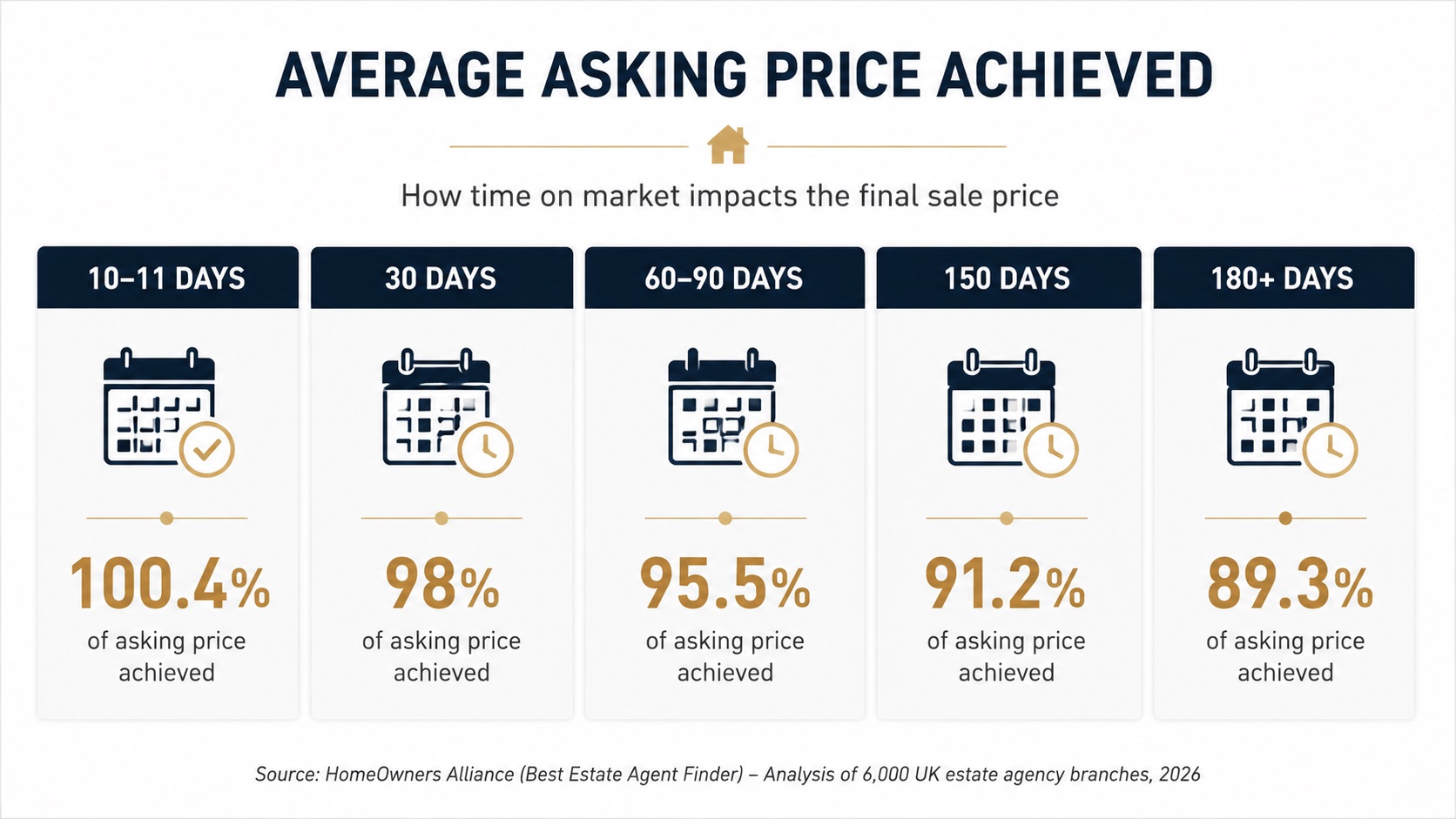
Research from the wider UK market illustrates just how valuable that initial period can be. A 2026 analysis covering around 6,000 estate-agent branches found a sweet spot around 10–11 days, while properties selling too quickly - seven days or fewer - achieved considerably less, around 94.1% of asking price. (Source: HomeOwners Alliance / Best Estate Agent Finder, 2026)
As properties remained on the market for longer, the percentage of asking price achieved tended to fall.
That doesn't mean that every property should be priced to sell within ten days. Nor does it mean that a property which takes six months to sell is automatically overpriced.
What it does demonstrate is something important: there can be a financial cost to losing momentum.
The danger of “testing the market”
One of the most common conversations between an agent and a prospective seller goes something like this:
“Let's put it on at £500,000. We can always come down.”
It is an understandable approach. Sellers naturally want to achieve the highest possible price, and the asking price can feel like the starting point of a negotiation.
But an asking price isn't simply a number on a listing. It is a marketing decision.
If the price is too ambitious, buyers who would otherwise be interested may never arrange a viewing. They filter the property out of their search. Some may look at it, compare it with better-value alternatives and move on.
And after several weeks, something else happens.
The property starts to look less new.
The photographs are familiar. Buyers have seen the listing before. Agents have already discussed it with their clients. The initial wave of interest has passed.
This is where the psychology of the market becomes particularly important.
A buyer may start asking:
Why hasn't it sold?
Has someone found a problem with it?
Is the seller unrealistic?
How much below the asking price will they actually accept?
The longer the property remains unsold, the more likely those questions become.
Price reductions don't always solve the problem
A reduction can certainly generate renewed interest. But it may not completely undo the effect of an overpriced launch.
Recent research from Savills found that realistically priced properties in the UK typically received an offer within around 28 days. Properties requiring a price reduction could take more than 100 days, while those requiring two reductions could take more than five months. (Source: Savills, 2026)
The pattern is revealing.
The property hasn't necessarily become worse. The market hasn't necessarily changed dramatically. In many cases, the issue began with the price.
That creates a familiar sequence:
Too high an initial price → fewer viewings → fewer offers → property becomes stale → price reduction → buyers perceive weakness → lower eventual price.
It is entirely possible, therefore, for a seller to think:
“I'll start at £500,000 and eventually accept £475,000.”
when a better strategy might have been:
“I'll launch at £475,000, create strong initial interest and potentially achieve £480,000–£490,000.”
The objective isn't necessarily to sell quickly at any price.
It is to find the price that attracts the right buyers while maximising the eventual result.
Why Gibraltar is different
This question becomes particularly interesting in Gibraltar.
Gibraltar is a relatively small property market. There are fewer properties, fewer active buyers and, importantly, a much smaller pool of people actively looking at any particular type of property.
That may make days on market an especially important signal in Gibraltar.
In a large city, a property can potentially sit quietly among thousands of listings. In Gibraltar, a property that has been available for six or nine months can become familiar to a significant proportion of the active market.
Buyers may have seen it several times.
They may have watched the price change.
They may have viewed comparable properties.
And they may have formed an opinion about what the seller is likely to accept.
This doesn't mean that a property which has been on the market for months cannot achieve a good price. It absolutely can.
But it does mean that the circumstances surrounding that time on the market matter.
Sometimes the property isn't the problem
There is an important distinction here.
A long time on the market doesn't necessarily cause a lower sale price.
More often, incorrect pricing and ineffective marketing can cause both.
A good example comes from a recent sale we agreed in Europa Walks, where a two bedroom house had been marketed by eight different agents for more than two years without selling. It was subsequently removed from the market and relisted just by Richardsons at the same asking price, but with a different strategy - and a sale was agreed within seven days.
The asking price hadn't changed, the strategy had.
That is a useful reminder that selling property is not simply about choosing a number and putting an advert online. Presentation, positioning, photography, exposure, buyer targeting and the agent's strategy can all influence the outcome.
So, what's the sweet spot?
For sellers, perhaps the most useful question isn't:
“How much can I get for my property?”
It is:
“How much can I realistically achieve, and how long am I likely to have to wait to achieve it?”
Those two things need to be considered together.
Imagine two possible strategies for a property:
| Strategy | Asking price | Possible outcome | Potential timeframe |
|---|---|---|---|
| Test the market | £500,000 | £475,000 | 6–9 months |
| Price competitively | £475,000 | £480,000–£490,000 | Potentially quicker |
(Illustrative example — not a prediction of market value or sale price)
The second strategy doesn't guarantee a higher price. No responsible agent can promise that.
But it demonstrates why asking price and time on market should never be considered independently.
A seller might achieve more by accepting a lower initial asking price if that price generates significantly greater competition.
The question worth asking your agent
Before putting your property on the market, don't just ask:
“What do you think it's worth?”
Ask:
“What price would give us the best chance of attracting serious buyers in the first few weeks - and what evidence supports that?”
A good valuation should consider comparable properties, recent transactions, current competition, demand, property condition and the likely buyer pool.
It should also consider strategy.
Because ultimately, the highest asking price isn't necessarily the highest price you will achieve.
The real skill is finding the point where price, demand and timing intersect.
In a market as closely connected as Gibraltar, that first impression can be particularly valuable.
Your property only gets one chance to be new to the market.
The question is: what price do you want buyers to see when it is?
Thinking of selling in Gibraltar?
Before you decide on an asking price, speak to our team about how your property should be positioned, priced and brought to market.