Cumberland Steps: Where the Land Is Older Than the Buildings
Economy | 23 Sep 26, 00:00
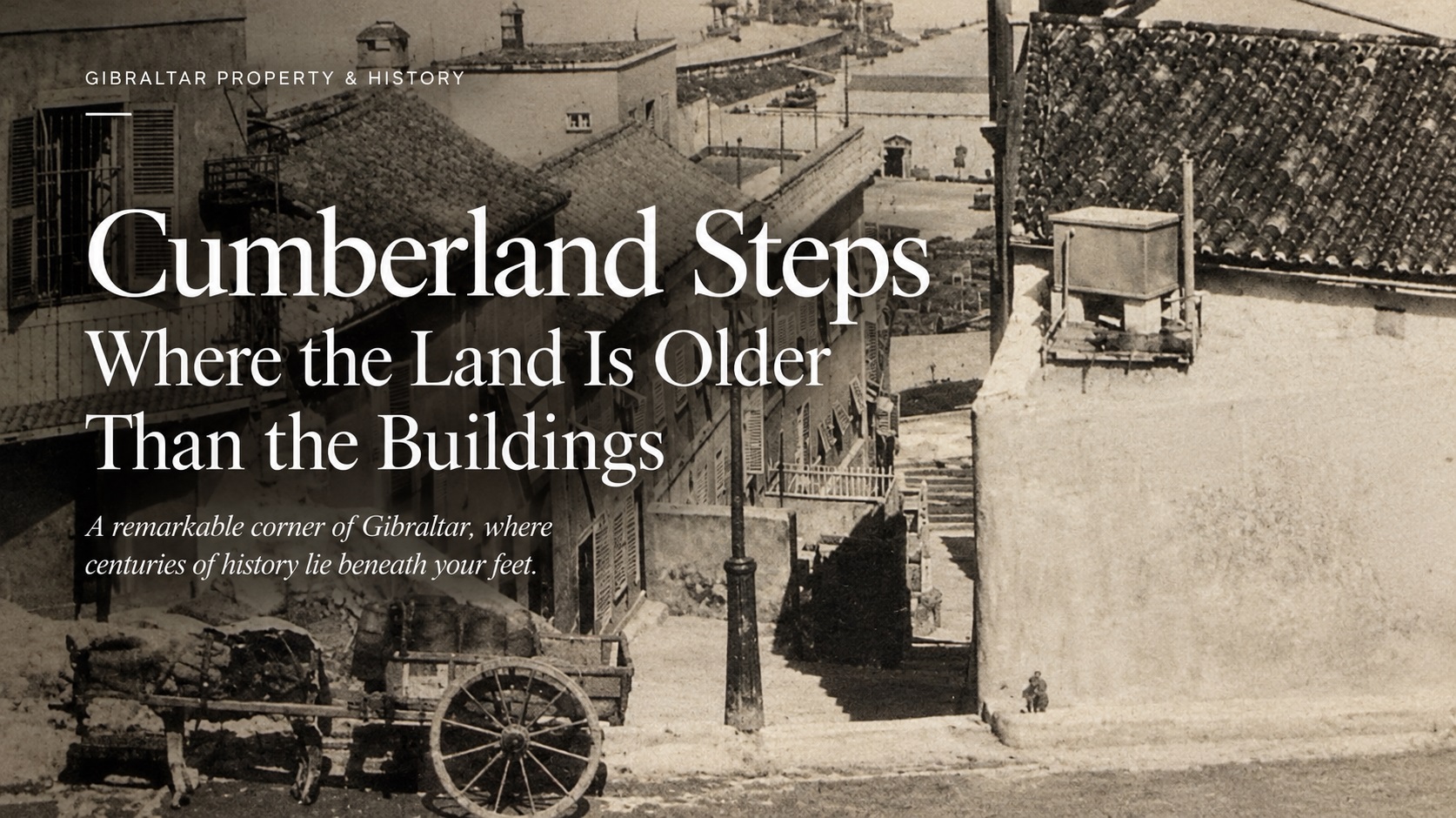
There are streets in Gibraltar where the history is visible in the architecture. Cumberland Steps is rather more intriguing: here, some of the most interesting history is beneath your feet.
Climbing Cumberland Steps today, it is easy to think of it simply as another of Gibraltar's distinctive residential streets. Houses and apartments rise with the slope of the Rock, terraces catch the light, and the narrow passageways retain something of the character that makes Gibraltar's older residential areas so distinctive.
Yet look a little more closely and the story becomes considerably more interesting.
A Name with a History
The name itself is not as old as the land on which the street stands. Historical records place the name Cumberland Steps in the late nineteenth century, with other Cumberland references appearing in Gibraltar during the preceding years. The name is generally associated with Prince William, Duke of Cumberland, who visited Gibraltar in 1768.
Before that, however, the steps were known by another name: La Escalerita de Piri, or Escalera de Piri. It is a wonderfully evocative reminder of the Mediterranean character of early civilian Gibraltar. The name appears in historical records well into the twentieth century, while the reference to Piri is generally associated with Franco Piri, a Genoese master mariner who was living in Gibraltar in the early nineteenth century.
So even before considering the buildings themselves, Cumberland Steps already has several layers of history - British military Gibraltar, Mediterranean civilian Gibraltar and the gradual development of the town that would eventually become the Gibraltar we recognise today.
The Story Beneath the Street
But it is the story of the land that makes the area particularly fascinating.
Gibraltar's early property system was not quite the straightforward arrangement we might imagine today. Long before modern conveyancing, the authorities were recording who occupied properties, who held interests in them, what had been built and what rents were payable to the Crown. The 1749 Bland Court of Enquiry into Property Grants provides a remarkable glimpse into this world, recording proprietors, tenants, dwellings and ground rents and, in doing so, revealing just how established private property interests had become.
Earlier eighteenth-century records are equally revealing. They distinguish between existing houses, properties acquired and subsequently repaired or rebuilt, and buildings constructed on land that had been allocated for development.
That distinction matters.
Because in a place such as Gibraltar, a building could disappear without the history of the property disappearing with it.
A house might be altered, rebuilt or replaced, while the underlying plot and its ownership continued through successive generations. The physical building could therefore be relatively young, while the property beneath it could have a history stretching back more than two centuries.
When the Buildings Changed
Cumberland Steps provides a particularly good illustration of this.
The buildings associated with the properties featured here date from the 1950s. Yet the freehold plots on which they stand have roots reaching back to the 1760s.
At first glance, that may seem an odd combination. How can a property have an eighteenth-century history if the building itself is only around seventy years old?
The answer is that the two histories are not the same.
The post-war years transformed much of Gibraltar's residential landscape. After the evacuation of the civilian population during the Second World War, the returning population faced an acute shortage of housing. Older buildings were repaired and adapted, while new buildings appeared as Gibraltar rebuilt and modernised.
It would be tempting to assume that every later building replaced something destroyed during the war, but the surviving records do not always allow such a neat conclusion to be drawn for individual properties. What we can say is that post-war rebuilding introduced a new generation of buildings onto a much older pattern of ownership and land division.
And that is precisely what makes Cumberland Steps so interesting.
The architecture may belong to one era while the land belongs to another.
Two Different Forms of Ownership
Today, that history presents itself in two quite different forms of ownership.
One of the properties currently being offered through Richardsons Properties is a substantial four-bedroom freehold house on Cumberland Steps. It is a sizeable home, with accommodation arranged over several levels, generous terraces and private outdoor space. But beyond its size and character, there is something particularly significant about its tenure.
It is freehold.
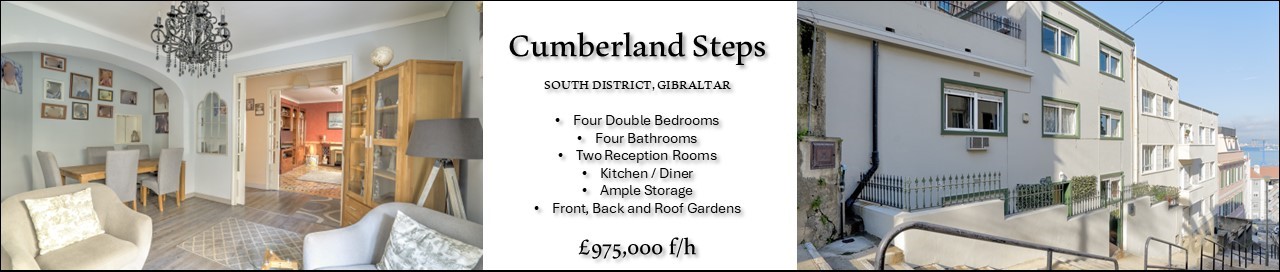
The freehold is the ownership of the property itself rather than simply a long-term lease over somebody else's freehold interest. In the context of Cumberland Steps, that connects the property to the much longer story of Gibraltar's historic land ownership.
A short distance away, another property tells the story from a different angle.
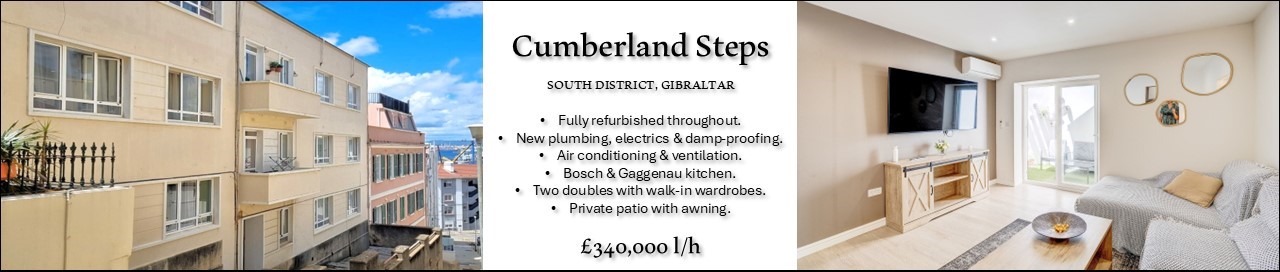
A beautifully refurbished two-bedroom apartment, also on Cumberland Steps, occupies part of a 1950s Art Deco-inspired building. The apartment itself has been comprehensively modernised, with new plumbing and electrics, air conditioning, contemporary finishes and a private patio, while retaining the character of the original building.
Its tenure, however, is different.
The apartment is held on a 999-year lease. Again, the freehold of the building belongs to a private entitiy and not to Government (LPS), so the freeholder is able to grant a lease to the apartment owner with an exceptionally long-term interest in the property.
It is an interesting distinction, particularly in a place where the history of the underlying land can stretch back much further than the building standing upon it.
A Street Built in Layers
And suddenly, Cumberland Steps begins to look less like simply a residential street and more like a living record of Gibraltar's development.
The eighteenth-century property plots belong to one chapter. The nineteenth-century Cumberland name belongs to another. The old vernacular name of Piri recalls an even earlier Mediterranean character. The pre-war streetscape tells another story, while the 1950s buildings reflect Gibraltar's post-war rebuilding and the changing demands of a growing population.
Today, those same plots have become highly desirable homes.
That is perhaps the most fascinating thing about historic property in Gibraltar. We often think of age in terms of architecture - the date carved into a stone, the style of a façade, the shape of a window or the materials used in its construction.
But property has another kind of age.
There is the age of the building, and then there is the age of the land beneath it.
On Cumberland Steps, those two timelines are separated by almost two centuries.
And perhaps that is why this particular corner of Gibraltar feels so distinctive. The buildings may belong to the twentieth century, but the story beneath them reaches back to the eighteenth.
Sometimes, the oldest thing about a property isn't the building. It's the land.